Skip to content

Refining pistachio paste to 9 μm with the Fristam FCM Colloid Mill

Pistachio paste trials in Sicily achieved 9 μm after screening pre-refined paste, with flow rates tested up to 850 kg/h.

TRIAL AN FCM

Introduction to the application and industry overview

Fine particle size and a uniform texture are key requirements in premium nut paste production. Manufacturers must balance the level of refining required for a smooth finished product with processing time, throughput and temperature control.

For pistachio processors, inline colloid mixing offers a potential route to finer texture while retaining existing upstream equipment. The Fristam FCM Colloid Mill applies intensive rotor-stator shear to reduce particle size and improve product uniformity in a continuous inline process.

Customer brief

A pistachio products manufacturer in Sicily wanted to improve the refining of its pistachio paste. Its existing two-stage ball-mill process achieved a final particle size of approximately 30–35 μm, but required long processing times and was limited to a maximum throughput of around 350 kg/h.

The manufacturer wanted to assess whether the Fristam FCM could:

    • Replace the second refining stage, ideally with a single pass.
    • Provide an additional final polishing stage for premium “silk” products requiring particle sizes below 20 μm.
    • Process paste at higher flow rates while improving finished texture.

Previously unsuccessful methods

The existing process combined pre-grinding of whole pistachios with a second ball-mill refining stage. Although it produced paste at approximately 30–35 μm, it had not delivered the finer particle size required for the proposed premium products.

The main limitations were extended processing times, a throughput ceiling of around 350 kg/h, and the need for further refining to achieve the below-20 μm target. The trial therefore focused on improving the refining stage while continuing to use the manufacturer’s existing pre-mill.

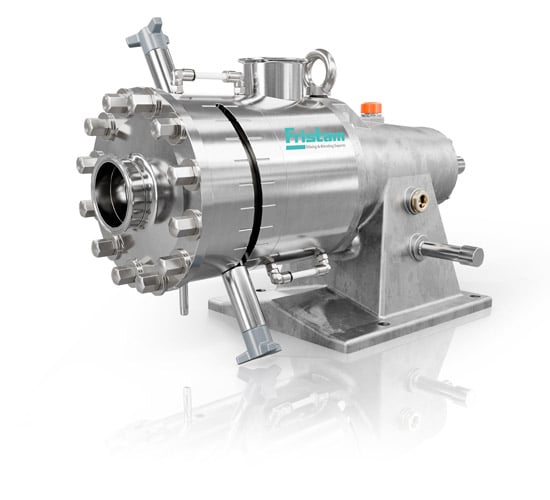
Pistachio Paste Process Machine - Fristam FCM

Fristam’s solution

Fristam’s application specialists tested the FCM Colloid Mixer downstream of the existing pre-milling equipment. As the paste passes through the narrow gap between the high-speed rotor and stator, intensive shear reduces particle size and produces a finer, more uniform texture.

The adjustable rotor-stator gap allowed the team to evaluate different settings and identify a balance between particle size reduction and product temperature. The trials assessed both the FCM’s potential to take over part of the existing refining process and its use as a final polishing stage for already-refined paste.

Trial set-up

1. Preparation of the pistachio paste
Whole pistachios were processed through the manufacturer’s existing pre-mill, which was jacketed and cooled with chilled water. A small amount of vegetable oil was added during pre-grinding to improve processability. The paste entering the FCM had a viscosity of approximately 5,000 cP.

2. Integration into the existing process
An existing pump fed the paste through the FCM at trial flow rates of 600 and 850 kg/h. A partially throttled discharge valve increased residence time in the mixer and helped improve particle size reduction.

3. Optimisation of the shear settings
The best overall results were obtained at 50 Hz with the adjustable FCM opening set to 50%. Increasing speed to 60 Hz delivered negligible additional particle size reduction, while closing the gap fully caused a significant temperature increase.

4. Evaluation of particle size and temperature
The team compared results for paste at different incoming particle sizes. Final measurements were taken after a vibrating screen removed remaining pistachio skin and other impurities. Product temperature was also monitored to identify cooling requirements for further optimisation.

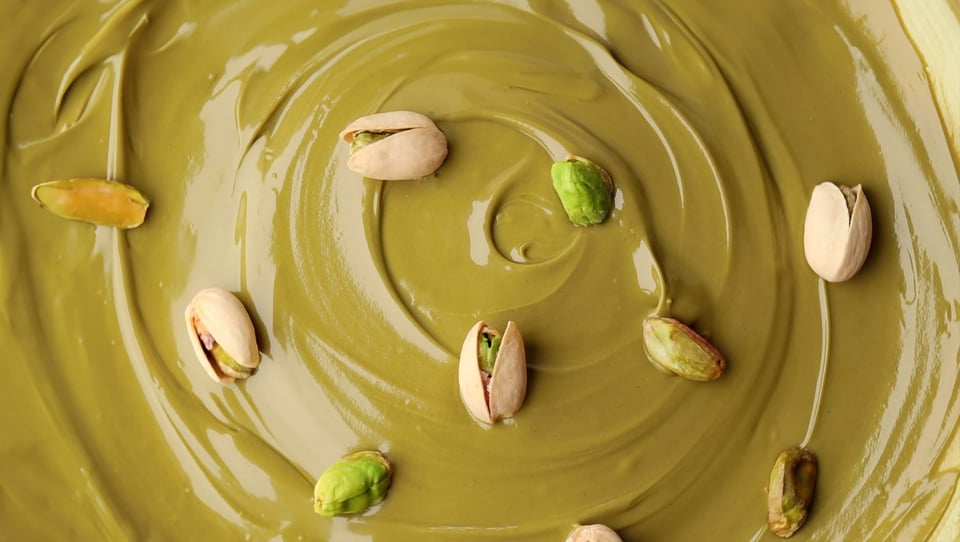
fristam-fcm-colloid-mixer

A successful outcome with Fristam's FCM

The trials demonstrated that the FCM could achieve particle sizes below 20 μm when the incoming paste had already undergone preliminary refining.

    • In one test, particle size decreased from 95 μm to 45 μm in a single pass.
    • In another, paste entering at 35 μm achieved a final measured particle size of 9 μm after FCM processing and vibrating screening.
    • Trial flow rates reached 850 kg/h, more than twice the existing ball-mill system’s maximum throughput of around 350 kg/h.

The trial in Sicily achieved a final measured particle size of 9 μm after screening pre-refined pistachio paste, with improved emulsion quality and texture compared with the existing ball-mill process. Inline flow rates were tested up to 850 kg/h, supporting the FCM’s potential as a final polishing stage for premium pistachio paste or a partial replacement for ball-mill refining. Further testing will assess temperature control and repeatability against the required product specification.

Do you have any questions so far?

Please don’t hesitate to contact our customer support. We would be happy to answer any questions you may have about our case studies or similar challenges, and we will provide effective solutions tailored to your needs.

Contact us
Process/Product benefits

Process/Product benefits

  • Fine particle reduction: A final measurement of 9 μm was achieved after processing and screening paste pre-refined to 35 μm.
  • Improved texture: The trial report recorded a finer emulsion and improved texture compared with the existing ball-mill process.
  • Higher trial flow rates: The FCM was tested at 600 and 850 kg/h.
  • Adjustable refining intensity: Gap adjustment allowed the team to balance particle reduction against temperature rise.
Sustainability benefits

Sustainability benefits

The trial explored an upgrade that retained the customer’s existing pre-milling equipment, offering a potential route to make continued use of installed process infrastructure.

Processing was faster, reducing energy consumption.

Financial benefits

Financial benefits

  • Potential capacity improvement: Higher flow rates reduce the refining bottleneck.
  • Targeted process investment: The FCM can be retrofitted into the process to improve it, reducing CAPEX costs.
  • Premium product development: The below-20 μm result supports further evaluation of finer-textured pistachio products.
Other benefits

Other benefits

On-site application support: Testing took place at the manufacturer’s facility with Fristam specialists under actual site conditions.

Similar applications

The results suggest potential for other nut and seed processing applications where fine particle size, smooth texture and consistent product uniformity are important. These include:

    • Hazelnut and almond pastes for confectionery, bakery fillings and dessert ingredients.
    • Peanut butter and other nut butters, including cashew and mixed-nut spreads, requiring a finer texture.
    • Praline pastes, chocolate–nut spreads and confectionery fillings where particle reduction contributes to a smooth mouthfeel.
    • Tahini and sesame paste, as well as sunflower and pumpkin seed pastes, requiring fine grinding and uniform consistency.
    • Nut-based creams and dessert sauces where refining and homogenisation may improve finished texture.

For manufacturers looking to refine nut paste, reduce graininess in nut butter or improve seed paste texture, the FCM could be evaluated as an inline polishing stage or a partial alternative to ball-mill refining.

Frequently Asked Questions

Yes. In this trial, paste pre-refined to 35 μm achieved a final measured particle size of 9 μm after FCM processing and vibrating screening. The result depended on preliminary refining of the incoming paste.

In addition to mixing & blending technology – check out Fristam’s full range of pumping technologies suitable for various industries.

GO TO FRISTAM PUMPS

Share this content