Process / Product quality benefits
- Intensive shear supports close contact between oil and acid.
- Combined mixing and transfer time reduced by approximately 50%.
- Configuration refinement addressed mixing and hydraulic requirements together.
Choose your region
Content on this site is tailored by region. Pick the one that applies to you.
Inline oil-and-acid mixing with the Fristam FS Shear Blender
TRIAL AN FS Shear BlenderDegumming is an early stage in vegetable oil refining that removes phospholipids, commonly known as gums, and other impurities before further processing. In acid degumming, effective contact between the oil and treatment medium helps prepare non-hydratable phospholipids for subsequent removal.
Mixing equipment must provide this contact while meeting the line’s flow and pressure requirements. For processors using tank-based systems, the arrangement can also affect processing time, installation space, cleaning and maintenance.
For pistachio processors, inline colloid mixing offers a potential route to finer texture while retaining existing upstream equipment. The Fristam FCM Colloid Mill applies intensive rotor-stator shear to reduce particle size and improve product uniformity in a continuous inline process.
An edible oil processor in India wanted to simplify the oil-and-acid mixing stage of its degumming process. Working with the customer’s original equipment manufacturer (OEM), Fristam assessed whether an inline shear blender could replace the existing tank mixer.
The customer needed effective mixing alongside the required transfer performance. Supplied operating parameters included viscosity of 1–20 cP, temperature of 20°C–70°C, density of 0.8–1.05 g/cc and required discharge pressure of up to 4.5 bar. The objective was to shorten the combined mixing and transfer operation while creating a more compact, accessible equipment arrangement.
The existing tank-type dynamic mixer performed the mixing duty, but its wider operating requirements limited the process. Mixing and transfer together took approximately two hours.
The tank, separate agitator and associated equipment occupied substantial installation space and required more maintenance activity. Cleaning also depended on a separate clean-in-place (CIP) arrangement with a spray ball.
The opportunity was to replace a functioning but cumbersome mixing stage with an inline arrangement that could address both mixing and transfer requirements.
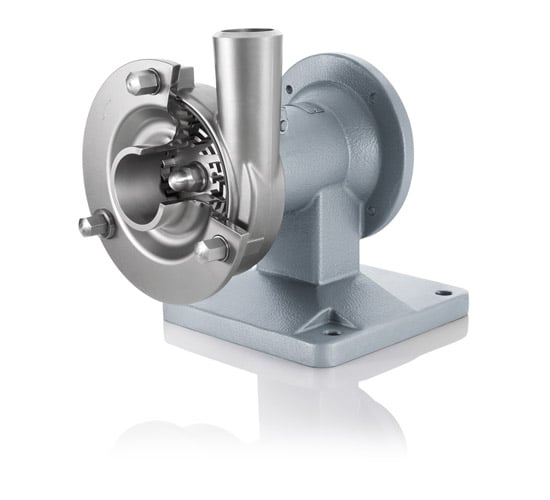
Fristam selected the FS Shear Blender as an inline alternative. Its rotor-and-stator system subjects the passing product to intensive shear, supporting dispersion and continuous blending of multiphase liquids. In this application, that action provided close contact between the oil and acid while combining mixing and transfer in one compact unit.
Fristam supplied the equipment through the OEM, and its service team supported commissioning and process trials at the customer’s facility. The initial configuration provided the required mixing action but did not generate the required discharge pressure.
Fristam subsequently supplied an alternative 2121 impeller configuration to address the hydraulic requirement alongside the shear duty. This commissioning work allowed the arrangement to be refined using actual process performance. The installed inline blender could also be cleaned using hot water.
Process set-up
Following installation and optimisation, combined mixing and transfer time fell from approximately two hours to approximately one hour - a reduction of approximately 50% for this process stage.
The customer also gained a more compact arrangement, easier maintenance access and less dependence on a separate tank agitator. Hot-water cleaning of the inline blender simplified the cleaning arrangement around the mixing stage.
The shorter operation freed time within this stage of production. Any increase in overall plant output would depend on upstream and downstream constraints, but the installation demonstrated a practical opportunity to simplify tank-based oil-and-acid mixing.
Considering an inline alternative for edible oil degumming? Fristam can review your oil-and-acid mixing duty, operating conditions and transfer requirements to help identify a practical equipment arrangement for your process.
Similar applications where this mixing approach may be relevant include:
Acid is dispersed into the oil to create close contact between the treatment medium and phospholipids. An inline rotor-and-stator mixer, such as the Fristam FS Shear Blender, generates intensive shear as the liquids pass through it. The mixing duty must be assessed alongside the wider treatment and separation process.
Effective mixing brings the acid treatment medium into contact with components that require treatment before separation. Poor distribution can leave parts of the oil less effectively treated. Mixing supports the degumming process, but it does not replace the necessary reaction conditions, residence time or downstream separation.
A processor may consider replacement when tank mixing creates avoidable delays, occupies valuable space or requires a complex maintenance and cleaning arrangement. In this project, the tank mixer performed its mixing duty, but an inline FS Shear Blender shortened combined mixing and transfer time and simplified the equipment layout.
The Fristam FS Shear Blender uses a rotor-and-stator system to generate intensive shear within the passing product. This supports dispersion of the treatment medium through the oil. The blender combines this mixing action with transfer, making hydraulic performance an essential part of equipment selection.
Time savings depend on the existing arrangement and required process duty. In this installation, combined mixing and transfer time decreased from approximately two hours to approximately one hour after optimisation. This result applies to that stage; it does not establish an equivalent reduction in total refining time.
No. Shear must suit the treatment duty and downstream separation process. Equipment selection should consider dispersion, flow, pressure and treatment conditions together. In this project, commissioning showed that satisfactory mixing action alone was insufficient because the initial configuration did not deliver the required discharge pressure.
Adequacy should be checked against agreed treatment and downstream separation requirements. Longer mixing time alone does not prove better dispersion. A process review should assess mixing performance alongside operating conditions and product-quality measurements; this project supplied no numerical phospholipid-removal or final-oil-quality results.
The inline FSP Shear Blender could be cleaned using hot water. The previous tank system required a separate CIP arrangement with a spray ball. Cleaning requirements remain specific to the installation and residues involved; the project did not quantify changes in cleaning time, water consumption or chemical use.
Shorter runtime can reduce energy consumption per operation where power demand and operating conditions are comparable. A reliable comparison requires actual operating power and runtime for both systems. This project documented a shorter mixing and transfer operation, but supplied no measured energy consumption or energy-cost savings.
The review should cover oil and treatment-medium properties, temperature, viscosity, flow, discharge pressure and integration with subsequent processing. Cleaning and maintenance access also matter. Commissioning should confirm performance under operating conditions, as this project required an impeller configuration change after the initial trial identified a pressure shortfall.