
New European Union restrictions on PFHxA and related substances became applicable to cosmetics on 10 October 2026, introducing strict limits on these persistent chemicals within the PFAS family.
Under Commission Regulation (EU) 2024/2462, cosmetic products must not be placed on the EU market or used if they contain concentrations equal to or exceeding:
- 25 parts per billion (ppb) for PFHxA and its salts combined.
- 1,000 ppb for PFHxA-related substances combined.
These limits are measured in homogeneous material. The regulation includes a derogation for articles and mixtures already placed on the market before 10 October 2026.
What do the new PFHxA restrictions mean for cosmetics manufacturers?
Not every cosmetics manufacturer will need to reformulate. However, where affected ingredients must be replaced, regulatory compliance is only part of the challenge.
Changes to functional ingredients can alter viscosity, dispersion behaviour, deagglomeration requirements, product texture and emulsion stability, potentially requiring manufacturers to reassess their mixing and homogenisation processes.
At Fristam Mixing & Blending, we help manufacturers address these challenges through specialist mixing technology, whether upgrading an existing cosmetics production line or introducing a new mixing system.
Can high-shear mixing improve cosmetic reformulation?
High-shear rotor-stator mixing can improve ingredient dispersion, break down agglomerates and support more uniform emulsions. This can be particularly useful when alternative ingredients behave differently during processing.
However, more shear is not always better. The correct mixing intensity depends on the formulation, especially when working with shear-sensitive ingredients.
Upgrade an existing process: FS Shear Blender and FCM Colloid Mill
The Fristam FS Shear Blender and FCM Colloid Mill can be integrated into suitable existing production systems to improve dispersion and homogenisation without necessarily replacing the entire mixing process.
The FS is designed for inline ingredient dispersion and homogenisation, with configurable rotor-stator technology to suit different processing requirements.
In one cosmetics manufacturing application, a specially configured FS reduced batch processing time from six to 3.5 hours while achieving homogeneous, lump-free mixing.
In another lotion production application, improved Carbopol dispersion was associated with reduced thickener consumption and reported annual ingredient savings of approximately $400,000 under the manufacturer's specific production conditions.
The FCM provides more intensive shear for applications requiring fine dispersion and emulsification. In a nutraceutical nano-emulsion application, an integrated system incorporating the FCM and a high-pressure homogeniser achieved a target droplet size of 0.2 µm.
Introduce a standalone system: PM and PM-D Powder Mixers
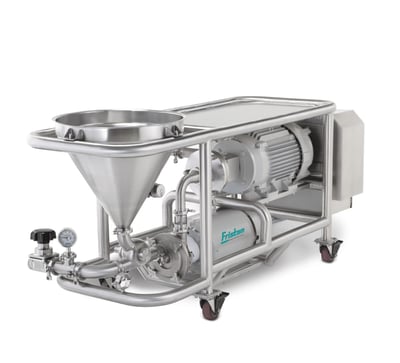
For manufacturers investing in new cosmetic mixing equipment, the Fristam PM and PM-D Powder Mixers provide standalone systems for incorporating powdered and liquid ingredients into a homogeneous blend.
These systems support efficient powder incorporation and dispersion in applications such as creams, lotions, gels and other personal care formulations, with the potential to reduce processing time and improve product consistency.
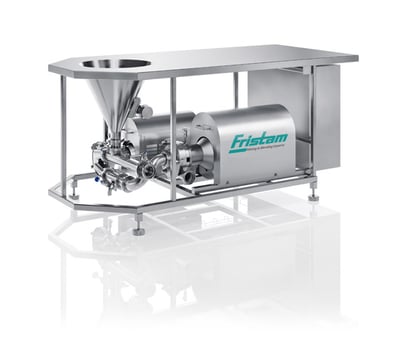
Introduce a standalone system: PM and PM-D Powder Mixers
For manufacturers investing in new cosmetic mixing equipment, the Fristam PM and PM-D Powder Mixers provide standalone systems for incorporating powdered and liquid ingredients into a homogeneous blend.
These systems support efficient powder incorporation and dispersion in applications such as creams, lotions, gels and other personal care formulations, with the potential to reduce processing time and improve product consistency.
Which mixing technology should you consider?
|
Processing requirement |
Fristam technology |
|
Inline ingredient dispersion and homogenisation |
|
|
Fine dispersion and intensive emulsification |
|
|
Incorporating powders into liquids to create homogeneous blends |
Equipment suitability depends on the formulation, viscosity, shear sensitivity and production requirements.
Reformulating cosmetics? Evaluate your process with Fristam.
With the PFHxA restrictions now applicable and wider European PFAS restrictions under consideration, manufacturers may wish to review their existing formulations and production processes.
Whether you're changing ingredients, improving dispersion or evaluating a new cosmetics mixing system, Fristam can help assess suitable mixing technologies.
Arrange a product trial or process evaluation with Fristam to discuss your application and manufacturing requirements.
Fristam's evaluations focus on mixing performance and equipment suitability, not verification of chemical regulatory compliance.