Introduction
For many manufacturers, improving mixing performance is often assumed to require a full system overhaul – however – it is possible to resolve many mixing challenges without replacing tanks, redesigning layouts or committing to major capital investment.
Upgrading industrial mixing without replacing tanks involves integrating inline equipment – such as shear blenders, colloid mixers or powder mixers – into existing processes to improve dispersion, consistency and processing speed without a full system redesign.
Common ways to upgrade industrial mixing without replacing equipment include:
- Adding an inline shear blender to a recirculation loop
- Installing a colloid mixer for fine emulsification
- Integrating a powder mixer for controlled ingredient induction
The key is not always replacing the system – it’s enhancing it with the right inline mixing technology.
Why traditional mixing systems limit efficiency
Many industrial mixing processes rely on tank agitation and bulk circulation. While effective for general blending, these systems often struggle to deliver consistent, high-intensity shear where it is needed.
This typically leads to longer batch times, repeated recirculation and uneven product quality. From an operational perspective, that means higher energy use, slower throughput and increased material waste.
These limitations are not always down to poor equipment – it could be that they are simply not the right type of equipment for that powder/liquid combination*. Bulk circulation cannot guarantee that every part of the product experiences the same level of shear.
Learn more about the behavior of different powder properties in mixing.
How to upgrade industrial mixing without replacing tanks
A more effective approach is to separate pre-mixing from final processing by integrating inline mixing systems into the existing process.
- The tank remains in place for ingredient blending and preparation
- Inline equipment is introduced after this pre-mixing/incorporation phase to deliver controlled, repeatable shear
This hybrid setup allows manufacturers to retain their current infrastructure while significantly improving mixing performance, batch consistency and processing speed.
Integrating shear blenders for consistent high-shear mixing
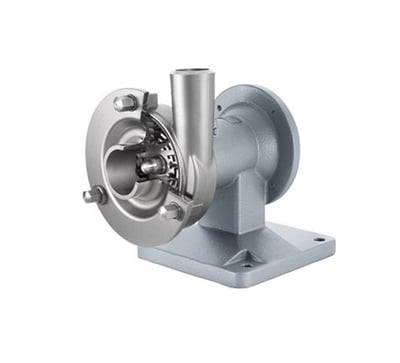
Fristam shear blenders are one of the most effective retrofit mixing solutions for improving dispersion and emulsification.
Installed within a transfer line or recirculation loop, they ensure that 100% of the product passes through a controlled shear zone. This eliminates the variability seen in tank-based systems and delivers consistent, repeatable results.
Example:
A food manufacturer producing shelf-stable salad dressings experienced ongoing issues with product separation due to inconsistent emulsification in a tank-based process.
By installing an inline shear blender downstream of the existing mixing system, the manufacturer achieved uniform droplet size and stable emulsions – without changing the tank or overall process.
This demonstrates a key principle: you don’t need to replace the system—you need to control the shear. Find out more here.
Avoiding CAPEX costs of a homogenizer by installing a Colloid Mixer
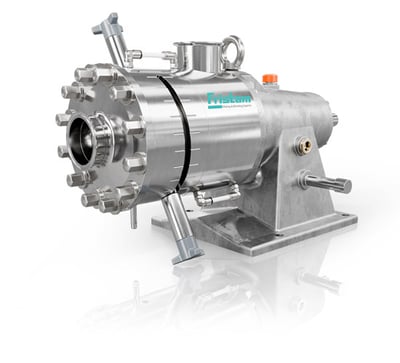
For applications requiring finer droplet or particle size reduction, Fristam Colloid Mixers can be integrated into existing systems to deliver more intensive high-shear processing.
This was demonstrated in beverage production, where a manufacturer producing a premium ready-to-drink cold brew experienced fat separation during shelf life. While the existing mixing system could disperse ingredients, it could not achieve the droplet size required for long-term stability.
Read more here: Eliminating fat separation.
Rather than installing a high-pressure homogenizer, the processor integrated a compact inline colloid mixer into the existing recirculation loop. This reduced droplet size to below 1 micron, eliminated separation and improved product stability—without major investment or process redesign.
This highlights how inline mixing upgrades can replace more complex and costly processing solutions.
How to integrate powder mixers into existing processes
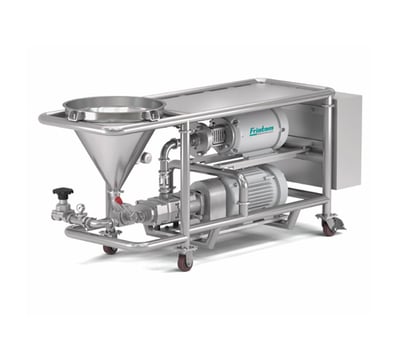
Powder mixers can be added to existing systems to improve how dry ingredients are introduced and dispersed. Instead of manual powder addition into tanks – where wetting and dispersion can be inconsistent – inline powder mixers allow controlled induction directly into the liquid stream. With an inline powder mixer, powders are tipped directly into a waist height hopper where they are immediately wetted with the liquid medium. The pre-mixed liquid and powder combination is then blended by a high-performance shear blender.
This improves:
- Wetting efficiency
- Dispersion consistency
- Batch repeatability
Like other inline mixing systems, powder mixers can be integrated without removing existing tanks, enabling a practical upgrade path without major process disruption.
A lower-risk, cost-effective upgrade path
From a project perspective, integrating inline mixing technology offers a significantly lower-risk alternative to full system replacement.
Typical advantages include:
- Retention of existing tanks and infrastructure, streamlining the site validation and approval process
- Minimal changes to plant layout
- Faster installation and commissioning
- Lower capital investment
- Reduced disruption to production
For many manufacturers, this makes inline integration a practical route to improving industrial mixing performance with limited expense and effort.
When integration makes the most sense
Integrating shear blenders, colloid mixers or powder mixers is particularly effective when:
- Product quality is inconsistent between batches
- Mixing times are longer than expected
- Dispersion or emulsification is incomplete
- Existing tanks are still fit for purpose
- A full system redesign is not commercially viable
In these situations, targeted inline upgrades deliver significant improvements without unnecessary complexity.
FAQ: Upgrading industrial mixing systems
Can I upgrade industrial mixing without replacing my tanks?
Yes. Industrial mixing can be upgraded by integrating inline mixing systems such as shear blenders, colloid mixers or powder mixers while retaining existing tanks for pre-mixing.
Where is inline mixing equipment installed?
Inline mixing equipment is typically installed in recirculation loops or transfer lines between the tank and downstream processing or filling.
What does an inline shear blender do?
An inline shear blender improves mixing by ensuring all product passes through a controlled high-shear zone, delivering consistent dispersion, emulsification and batch repeatability.
When should I use a colloid mixer?
A colloid mixer is used when finer droplet or particle size reduction is required, particularly in emulsions, beverages and high-performance formulations.
Do inline mixing upgrades require major plant modifications?
No. Most inline systems are compact and designed to integrate into existing processes with minimal disruption.
Conclusion
Improving industrial mixing does not require replacing your entire system, enhancements to an existing process with targeted inline mixing technology is an economical and effective solution.
By integrating shear blenders, colloid mixers or powder mixers, manufacturers can improve product quality, increase repeatability and accelerate production – while avoiding the cost and disruption of a full system overhaul.
For engineering teams, the advantage is clear: retain your infrastructure, upgrade your performance.