Sustainability benefits
- Lower energy usage due to reduced mixer runtime
- Less wasted product and fewer rework cycles
- More efficient use of thickening polymers

Content on this site is tailored by region. Pick the one that applies to you.
Mixing Carbopol with the Fristam Powder Mixer
GET IN TOUCHManufacturers of high-viscosity gels and personal care products must achieve reliable powder hydration and dispersion of functional polymers like Carbopol® to create stable formulations with consistent texture and viscosity. Traditional batch mixing methods can lead to clumping, long processing times, raw material waste, and cleaning challenges, hurting production throughput and product quality.
This case study shows how a Fristam Powder Mixer with integrated high-shear blending transformed gel production for a personal care products manufacturer, eliminating clumping, cutting blend time from hours to minutes, and saving over 2,000 process hours yearly.
A personal care products manufacturer was experiencing significant challenges in dispersing and hydrating Carbopol® 940—a common thickener used in gels, hand sanitizers, lotions, and similar formulations. Carbopol must be thoroughly wetted and activated in water, but the conventional batch process was not achieving this consistently.
Without proper hydration:
The customer’s goal was to reduce batch time, improve product consistency, and eliminate raw material waste due to incomplete dispersion.
The manufacturer had been mixing Carbopol in a batch tank equipped with a top-entry agitator and high-shear blade. While the slow agitator circulated the liquid, the mixer never fully dispersed the Carbopol on first pass.
Mixing in a batch tank with a top-entry agitator led to:
The process was inefficient and unpredictable, prompting the search for a more reliable inline powder-into-liquid mixing solution.
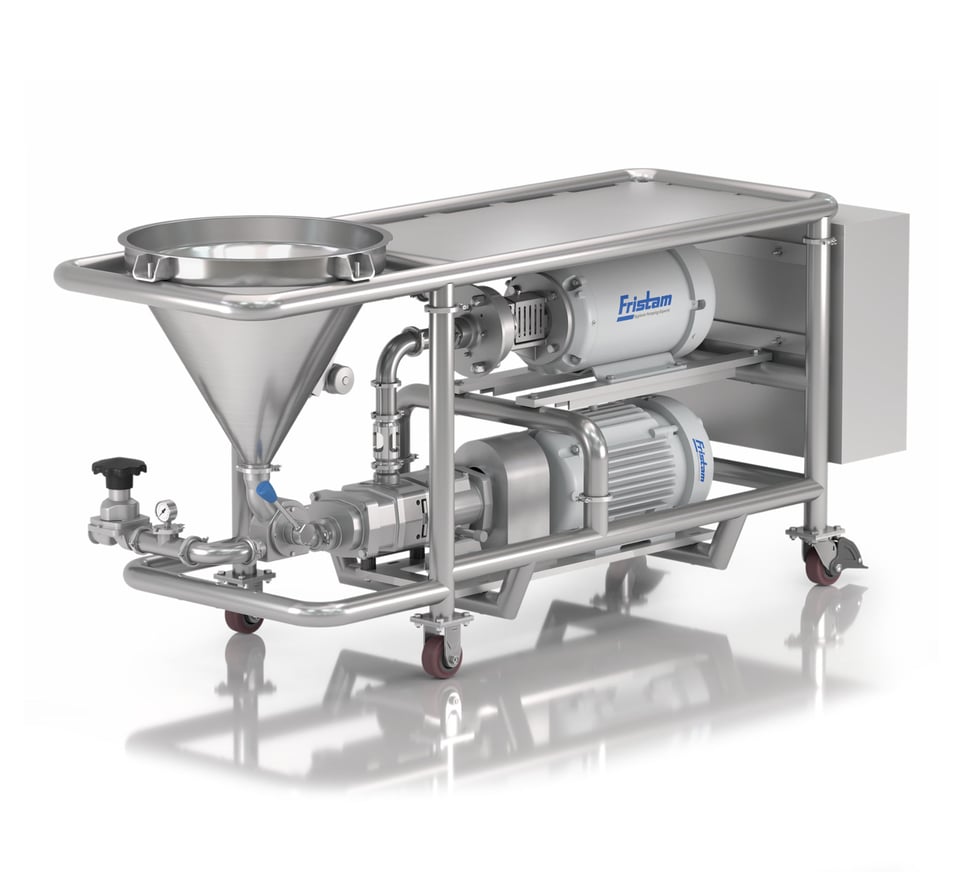
A Fristam Powder Mixer with optional vibrator was installed adjacent to the mixing tank. The Powder Mixer combined:
Trial set-up
1. The Powder Mixer was positioned at floor level beside the mixing tank.
2. Water was drawn into the system by the FZX Liquid Ring Pump and 40 kg of Carbopol was added directly into the tabletop hopper on the Powder Mixer.
3. The FZX pump pulled powder into the liquid – wetting it instantly.
4. This wetted pre-mix was then transferred to the FS blender, which applied high-shear rotor-stator mechanical forces to disperse the Carbopol and create a fully homogenous mix.
5. The gel then exited the Powder Mixer fully hydrated and ready for downstream processing.
6. Cleaning was completed using a CIP cycle following each production cycle.
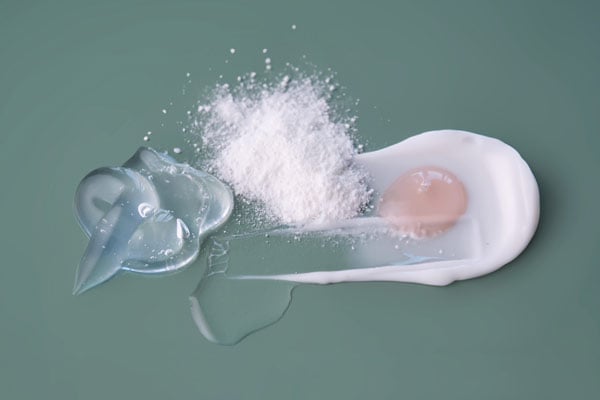
The Powder Mixer transformed the customer’s gel mixing process:
Manufacturers of shampoos, conditioners, lotions, gel sanitizers, and medical gels also benefit from similar performance improvements with Fristam Powder Mixer technology.
Please don’t hesitate to contact our customer support. We would be happy to answer any questions you may have about our case studies or similar challenges, and we will provide effective solutions tailored to your needs.
Inline powder-into-liquid mixing with controlled high shear enables immediate wetting, full polymer hydration, and uniform dispersion of Carbopol, producing stable gels with consistent viscosity and texture. The Fristam Powder Mixer is ideal for this task.
Top-entry agitators often fail to disperse the powder on first pass, leading to clumping, undissolved particles, extended mixing times, and the need to add extra polymer to reach target viscosity. Hygroscopic powders hit a body of water and instantly swell – which makes fisheye agglomerates a strong possibility whenever tank mixing is selected over inline Mixing.
High-shear mechanical forces rapidly break down agglomerates and evenly distribute hydrated polymer throughout the liquid, ensuring predictable rheology, smooth texture, and repeatable batch quality.
Yes. Immediate powder wetting and first-pass dispersion can reduce mixing time from several hours to minutes, delivering substantial annual process-hour savings and higher production throughput.
Complete polymer activation ensures stable viscosity, uniform suspension of active ingredients, consistent sensory feel, and reliable performance in gels, sanitizers, lotions, and medical formulations. It can also improve shelf life as it helps the product hold its consistency.
Common indicators include visible clumps, inconsistent viscosity, phase separation, excessive mixing time, raw-material overuse, and variability between production batches.
Closed powder-induction combined with clean-in-place capability simplifies sanitation, reduces contamination risk, and supports repeatable production aligned with pharmaceutical and personal-care manufacturing standards.
Efficient hydration reduces raw-material waste, shortens mixer runtime, lowers energy consumption, and minimises rework – improving both operational cost efficiency and environmental performance.
Yes. The same principles apply to shampoos, conditioners, lotions, gel sanitizers, polymer suspensions, and emulsified skin-care or medical gels where uniform viscosity and rapid batch processing are essential.
An upgrade is typically justified when existing processes create long batch times, persistent clumping, inconsistent gel rheology, excessive labour or energy use, and unreliable product quality that limits production efficiency.