Sustainability benefits
- Reduced energy usage due to shorter mixing time
- Improved utilisation of raw materials through complete dispersion

Content on this site is tailored by region. Pick the one that applies to you.
For the production of household detergents and polishers, using a Fristam Powder Mixer
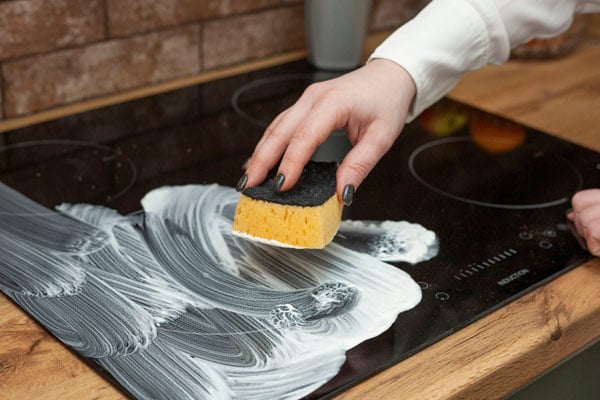
GET IN TOUCHManufacturers producing household detergents, hard-surface cleaners, degreasers, stove and oven cleaners, and metal polishing compounds must reliably disperse rheology modifiers, cellulose thickeners, and mineral abrasives into water-based formulations to achieve stable viscosity, controlled flow behaviour, and uniform suspension of functional particles.
Poor powder hydration during detergent or cleaner manufacture can lead to fish-eyes in CMC, undissolved polymer agglomerates, sedimentation of abrasive minerals, inconsistent rheology, and extended batch cycle times, all of which negatively impact cleaning performance, product stability, and manufacturing efficiency.
This case study demonstrates how a Fristam Powder Mixer with integrated high-shear dispersion enabled rapid hydration of carboxymethyl cellulose (CMC) and uniform dispersion of micronized mineral abrasives, significantly reducing batch time while improving formulation stability, rheology control, and production throughput in household-care manufacturing.
A manufacturer of household cleaners and polishing products required an efficient method for dissolving carboxymethyl cellulose (CMC) in water to stabilise a specialised stove cleaner. Proper hydration of the thickener was vital creating a quality product.
They also needed to disperse clay and quartz sand into thickened water to manufacture a metal-surface polishing compound. These mineral components must be uniformly distributed to ensure consistent polishing performance and product quality.
Their current process was taking over 2 hours per 1000kg batch – they needed to reduce this in order to keep up with the demand.
The customers previous tank-based agitation method of powder addition resulted in:
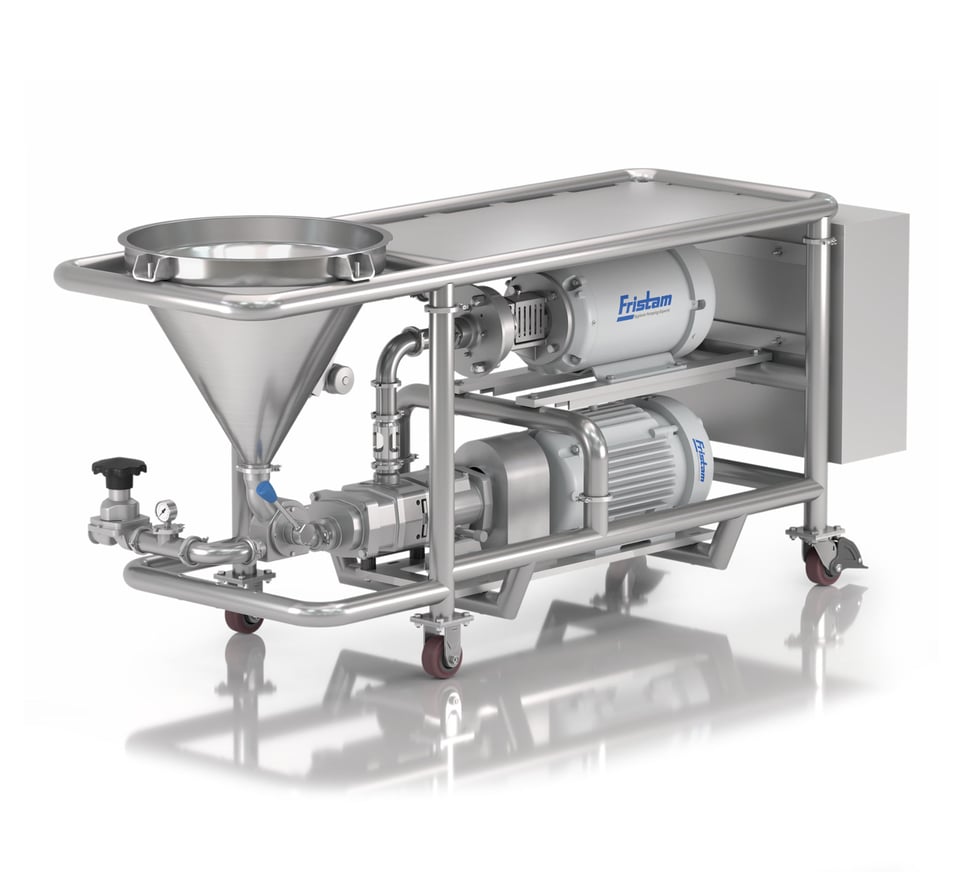
Fristam supplied a Powder Mixer system consisting of:
Trial set-up
For both products, the process was essentially the same.
1. CMC thickeners (for household cleaners) and micronized minerals such as clay and quartz (for the metal polish) were poured into the Fristam Powder Mixers hopper.
2. The FZ liquid ring pump, drew the liquid into the Fristam Powder Mixer.
3. Powders and liquids were instantly wetted at the first point of contact at the base of the hopper and were transferred towards the FS Shear Blender.
4. The FS Shear Blender dispersed the different powders and particulates using high-shear mechanical forces to force particles between the rotor and the stator – ensuring uniform dispersion and the total elimination of agglomerates.
5. The result for both products was a significantly reduced batch time – as the Fristam Powder Mixer successfully mixed the powders into liquid in just 10 minutes. Product consistency was also transformed.
The Fristam system reduced processing time from approximately two hours to around ten minutes per 1,000 kg batch, while also improving overall product quality and uniformity by eliminating thickener lumps in the detergent formulation.
Please don’t hesitate to contact our customer support. We would be happy to answer any questions you may have about our case studies or similar challenges, and we will provide effective solutions tailored to your needs.
Inline powder-into-liquid mixing with controlled high shear enables rapid wet-out, full polymer hydration, and uniform viscosity development, preventing fish-eyes, gel agglomerates, and incomplete thickener activation.
Bulk agitation often provides insufficient local shear to disperse powders immediately. This can lead to slow hydration, lump formation, viscosity variability, and extended recirculation times that reduce plant efficiency.
High-shear rotor-stator mixing ensures homogeneous distribution of thickeners, surfactants, and functional additives, producing stable viscosity, predictable flow behaviour, and consistent cleaning performance.
Poor dispersion can cause sedimentation, uneven abrasive distribution, inconsistent surface finishing, and batch-to-batch variability. Controlled shear mixing helps maintain uniform suspension and repeatable polishing performance.
Yes. Immediate powder wetting and rapid dispersion significantly shorten mixing cycles compared with traditional tank processes, improving throughput and reducing energy consumption.
Correct viscosity and suspension stability improve vertical cling, dwell time on soils, controlled pouring, and even distribution of active ingredients across treated surfaces.
Common indicators include visible lumps, unstable viscosity, phase separation, settling of abrasives, inconsistent cleaning results, and the need for filtration or rework.
Closed powder-induction systems with clean-in-place capability simplify cleaning, reduce contamination risk, and enable consistent, repeatable batch production in detergent and cleaner manufacturing.
Yes. The same dispersion principles apply to hard-surface cleaners, bathroom and kitchen detergents, automotive cleaners, technical cleaning fluids, and other water-based formulations requiring stable viscosity and uniform particle suspension.
An upgrade is typically justified when existing processes create long batch times, lump formation, unstable rheology, sedimentation of solids, excessive energy use, or inconsistent product quality that limits production efficiency.