
Sustainable hygienic mixing
How efficient powder-into-liquid processing supports ESG, reduces energy use and minimizes waste
GET IN TOUCH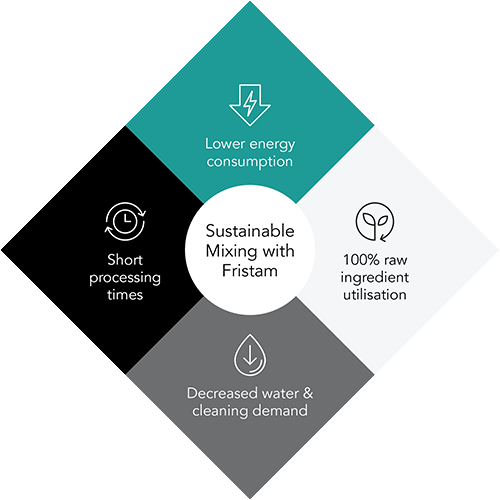
Open powder handling associated with tank-based or top-entry mixing can lead to airborne dust, product spillage, inconsistent incorporation and avoidable material loss – factors that increase both environmental impact and operating cost.
Fristam’s direct powder-induction and inline mixing systems help contain powders from induction through full dispersion, supporting:
- Reduced raw-material waste
- Lower dust emissions and product loss
- Decreased cleaning-chemical and rinse-water consumption
- Safer, more controlled hygienic processing environments
By improving material utilisation and minimising waste streams, efficient mixing supports manufacturing practices aligned with the waste-reduction principles of the EU Waste Framework Directive (2008/98/EC) and comparable waste-management objectives reflected in U.S. environmental legislation such as the Resource Conservation and Recovery Act (RCRA).
Energy performance in mixing is strongly influenced by dispersion efficiency, recirculation demand, shear control and total batch duration. Processes requiring long mixing times or repeated correction can significantly increase carbon footprint and operating emissions.
Fristam energy-efficient inline mixers and shear-blending systems are designed to:
- Achieve rapid, consistent powder dispersion
- Reduce recirculation and over-processing
- Shorten batch times and overall energy demand
- Enable stable, right-first-time production
Lower total energy consumption per unit of finished product contributes directly to reduced emissions and supports environmental-performance improvement consistent with industrial emissions-reduction objectives.
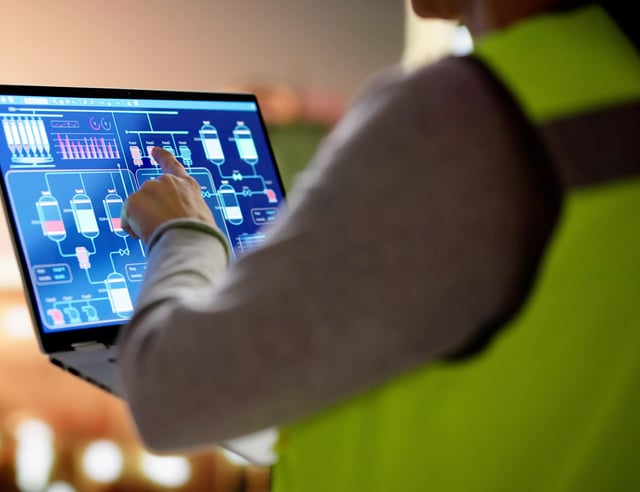
Sustainable manufacturing also depends on equipment longevity, maintainability and lifecycle resource demand. Fristam mixers are engineered for extended operational service using robust hygienic stainless-steel construction and proven clean-in-place (CIP) design principles.
Extended service life helps reduce:
- Replacement frequency and associated manufacturing impact
- Spare-part consumption and maintenance waste
- Lifecycle resource use over years of production
Durable hygienic equipment therefore contributes directly to long-term environmental performance and aligns with the continuous-improvement framework embedded in Fristam’s environmental strategy.
Manufacturers in regulated and consumer-facing sectors face growing expectations to demonstrate measurable progress in:
- Waste and raw-material reduction
- Energy and emissions intensity
- Water stewardship and cleaning optimization
- Safe, contained hygienic processing
Fristam Mixing & Blending technologies are developed to support these objectives through process-level efficiency improvements, enabling sustainability, engineering and operations teams to work toward shared environmental and economic targets.
Real-world production experience shows that meaningful sustainability gains often arise from reduced product loss, shorter processing times and improved batch consistency. Several Fristam case studies demonstrate measurable reductions in raw-material waste, energy consumption and cleaning demand, highlighting how sustainable mixing is achieved through engineering performance in practice.
Traditional top-entry tank mixing can force operators to carry heavy powder bags, climb ladders or platforms, and manually tip ingredients into open vessels. This increases the risk of falls, dust exposure, spillage and musculoskeletal strain – exactly the types of hazards that modern workplace safety frameworks are designed to reduce.
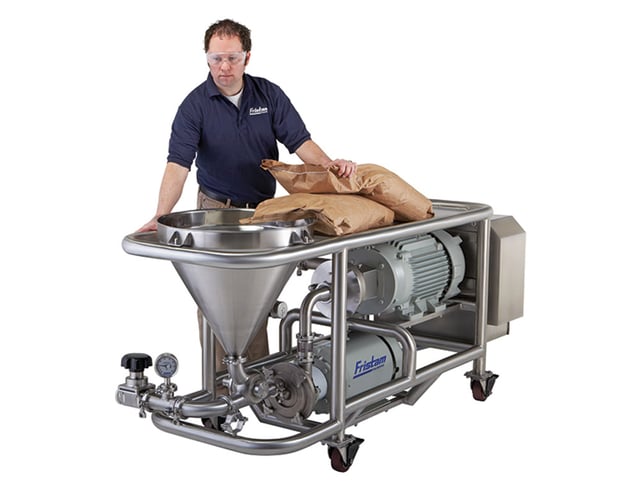
Fristam’s approach supports safer powder handling by keeping powder induction at waist height and enabling integration with big-bag feeding and closed transfer systems, reducing the need for working at height and lowering manual handling loads at the point of addition.
This design direction aligns with long-established regulatory principles:
- EU work-at-height requirements place duties on employers to select and use work equipment that protects against fall risk when work is carried out at height.
- The EU Manual Handling Directive (90/269/EEC) requires employers to avoid manual handling where possible, and where it cannot be avoided, to reduce the risk through organisational measures and appropriate means.
- In the United States, OSHA’s rules include requirements around safe use of walking-working surfaces and ladders, reinforcing the need to control/limit work-at-height hazards.
- OSHA also highlights ergonomics principles for reducing musculoskeletal disorder risks such as forceful exertion and awkward postures, which are common in repetitive bag lifting and overhead tipping.
Efficient powder-into-liquid processing, closed hygienic system design, reduced manual handling and durable long-life equipment remain central to Fristam’s vision of sustainable industrial mixing. By improving resource efficiency at the core of production – while also minimizing product loss, lowering energy demand and reducing the need for hazardous work at height – Fristam mixing technologies help manufacturers move toward lower emissions, safer working environments and more economically sustainable operations.

High‑shear carbopol dispersion reduces lotion blending time and saves $400,000 annually
Read case study
Powder Mixer solves safety hazard and cuts process time for starch production
Read case study
Accelerating fertiliser slurry preparation and eliminating nozzle blockage with Fristam Powder Mixer
Read case study